Conscience Independence
This term was born from a question that has become increasingly important to my work: how do we prepare physicians to remain fully engaged members of their profession without surrendering independent ethical judgment when the values around them begin to shift? By giving that capacity a name, I hope to contribute a framework that medical educators can examine, challenge, refine, and ultimately use to more intentionally prepare the physicians who come next.
-
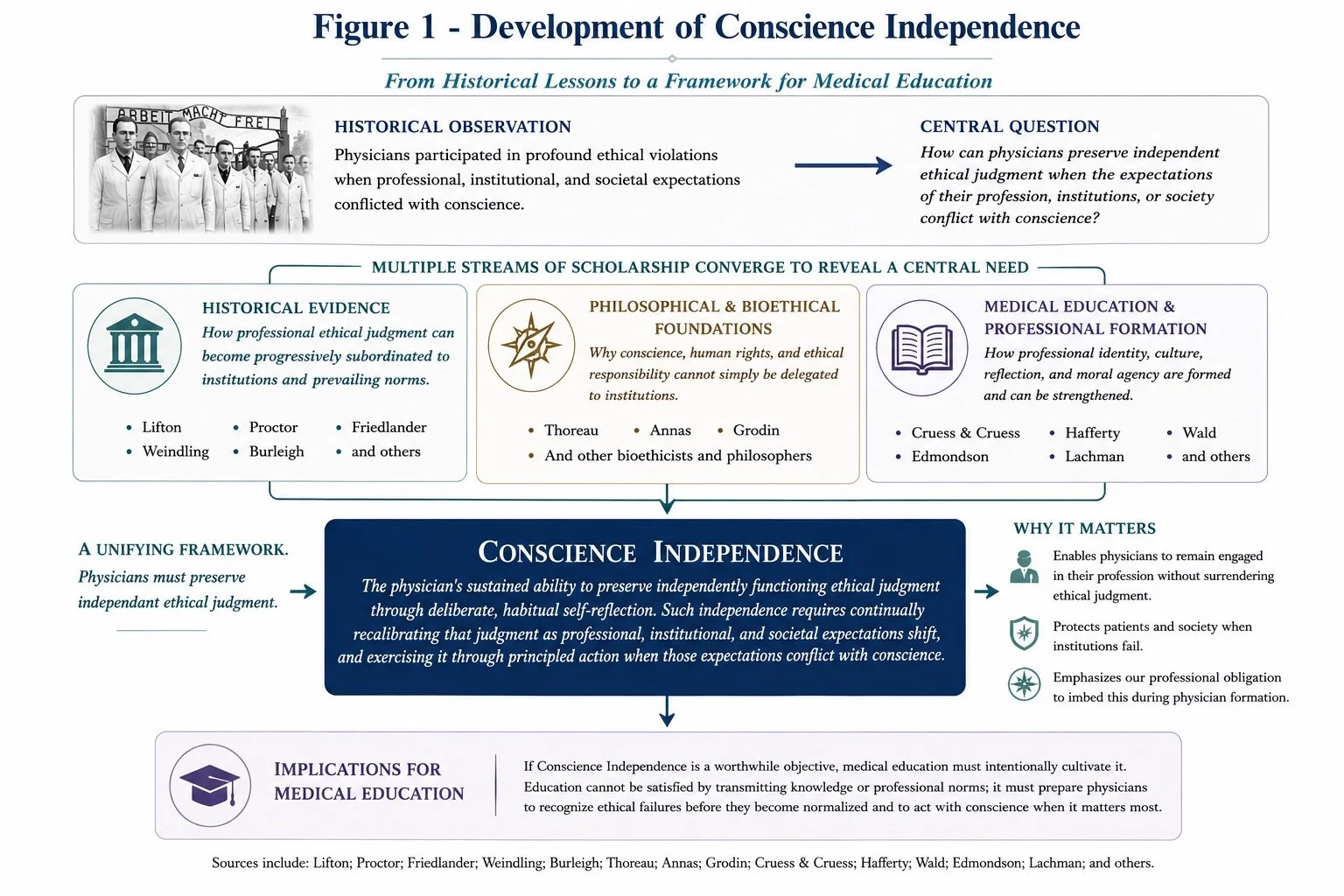
The physician's sustained ability to preserve independently functioning ethical judgment through deliberate, habitual self-reflection. Such independence requires continually recalibrating that judgment as professional, institutional, and societal expectations shift, and exercising it through principled action when those expectations conflict with conscience.
-
Conscience Independence is not independence from the medical profession. Physicians necessarily practice within communities, institutions, professional standards, and systems of accountability. Rather, it describes the capacity to participate fully in those systems without allowing them to replace one's own ethical judgment.
It requires physicians to repeatedly examine not only What is expected of me? but also Do I believe this is right? and to retain the capacity to act when those answers diverge.
-
My thinking about Conscience Independence emerged from studying physicians' participation in medicine under National Socialism. That history raises a disturbing professional question: how did physicians trained within a profession committed to healing come to participate in practices fundamentally incompatible with that obligation?
The history cannot be reduced to a single explanation. But it demonstrates the danger of assuming that professional norms, institutional expectations, or prevailing social values will themselves reliably preserve ethical medical practice. If physicians are to remain morally accountable for their actions, medical education must prepare them not only to understand the standards of their profession, but also to continually examine them.
-
Medical education devotes enormous attention to what physicians should know, what they should be able to do, and how they should behave. Professional formation also teaches learners to internalize the norms and values of medicine. That process is essential, but internalization alone is insufficient if physicians are to remain capable of recognizing when accepted norms themselves warrant examination.
I believe Conscience Independence must therefore be cultivated deliberately. Reflection, ethical reasoning, exposure to historical examples, meaningful feedback, and opportunities to navigate disagreement can help learners practice preserving independent judgment while remaining accountable members of the profession.
_________________________________________________________
The Scholarship
I developed Conscience Independence through ongoing scholarship examining physician moral agency, professional identity, medical education, and the history of medicine under National Socialism. The framework is intended not as a finished answer, but as an invitation to further scholarly examination of how medicine can cultivate physicians who remain both deeply engaged members of their profession and independently accountable moral agents.
_________________________________________________________